
Vijayawada centre · Instructor-led learning

Master Programme in AI Engineering Course in Vijayawada

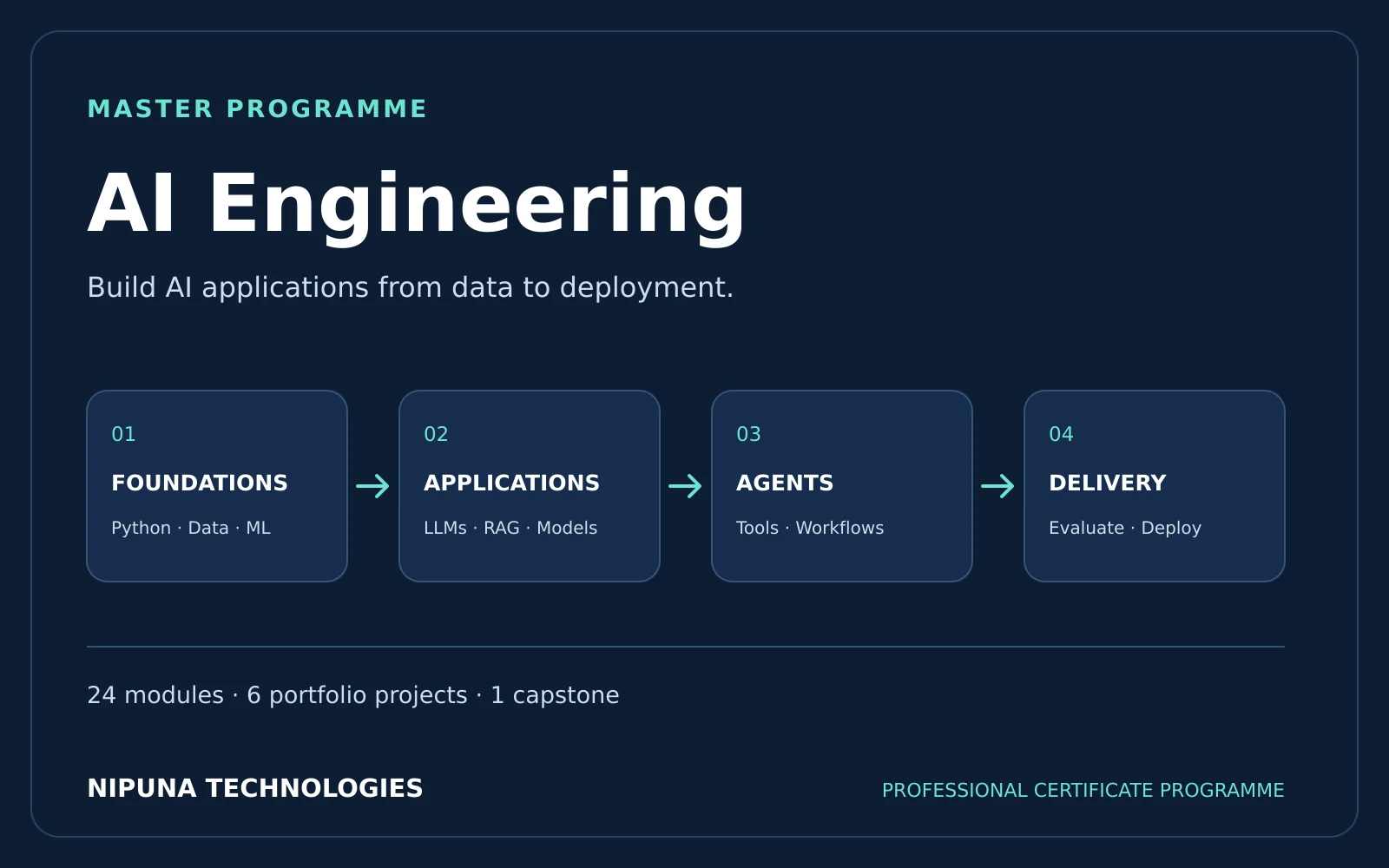
Build AI applications from data to deployment.

Explore AI engineering training with Nipuna Technologies in Vijayawada.

Python & GitSQL & PostgreSQLNumPy & pandasscikit-learnPyTorchHugging FacePostgreSQL + pgvectorLangGraph & MCPn8n & APIsFastAPI & DockerMLflowCloud deployment
Nipuna experience21+ years
Curriculum24 modules
Learning plan36 weeks · 360 guided hours
Learning supportLMS where applicable
GUIDED PRACTICAL LEARNING

Learn through logic, practice, testing and instructor guidance

Connect each course concept to a practical task, test the result and explain why the approach works.
Plan the logicPractise the skillTest edge casesExplain the result
AI Engineering learning pathway at Nipuna Technologies Vijayawada
21 years of coaching and training experience since 4 May 2005

The Nipuna learning support around this course

Exact availability is confirmed for the selected course, Vijayawada branch and current batch.

01

Experienced real-time trainers

Learn with trainer-led explanations, demonstrations and guided practice.

02

Class recordings where applicable

Ask the selected branch about recordings available for the current course and batch.

03

Nipuna LMS access

Use the learning platform and batch resources provided for the enrolled programme.

04

Practical labs, assignments and projects

Apply course concepts through the work planned for the selected programme and learner level.

05

Nipuna AI/LLM Career Guidance

Use structured guidance to compare roles, skills and practical next steps.

06

Career and placement assistance

Receive resume, interview and job-search support where applicable; employment is not guaranteed.

COURSE OVERVIEW

Build skills you can demonstrate

The Master Programme in AI Engineering is a professional certificate programme from Nipuna Technologies. It develops practical skills across data preparation, machine learning, deep learning, LLM applications, retrieval, agents, automation and deployment. The approved learning plan has 360 guided hours over 36 weeks, plus approximately 180 hours of independent practice. Guided hours include classes, supervised labs and project mentoring. This programme is not a university master’s degree.

PROGRAMME AT A GLANCE

A structured plan for your AI engineering journey

The approved learning plan; confirm your batch calendar, delivery mode and fee before enrolment.

01

36-week learning plan

Approximately nine months, with the exact calendar confirmed for your batch.

02

360 guided hours

Classes, supervised labs and project mentoring are included within this total.

03

180 hours of independent practice

Plan approximately five additional hours per week for assignments and project work.

04

24 modules and six portfolio projects

Build progressively toward a separate final AI service-desk capstone.

05

Optional 40-hour Python bridge

Additional preparation for learners who do not yet meet the Python entry requirement.

06

Professional certificate programme

Assessment-based training from Nipuna Technologies; not a university master’s degree.

12 LEARNING STAGES

360 guided hours, from foundations to delivery

Guided hours include classes, supervised labs and project mentoring. Independent practice is additional.

01

Python and software engineering

32 guided hours · Modules 1–2 · Build a tested, versioned Python component.

02

Data, SQL and mathematical foundations

28 guided hours · Modules 3–4 · Prepare data and explain the numerical foundations.

03

Applied machine learning

40 guided hours · Modules 5–6 · Compare and evaluate models without data leakage.

04

Deep learning and language models

30 guided hours · Modules 7–8 · Train a small network and understand language representations.

05

Generative AI applications

26 guided hours · Modules 9–10 · Build a model-backed interface with validated outputs.

06

Retrieval-Augmented Generation

32 guided hours · Modules 11–12 · Retrieve permitted evidence, cite sources and evaluate answers.

07

Model adaptation and multimodal AI

20 guided hours · Modules 13–14 · Run a small-model adaptation lab and document extraction exercise.

08

Agentic AI engineering

32 guided hours · Modules 15–16 · Build controlled tool-using agents with human approval.

09

AI automation and integrations

20 guided hours · Modules 17–18 · Connect business systems and handle duplicate or failed actions.

10

Evaluation, security and responsible AI

24 guided hours · Modules 19–20 · Apply quality gates and test access boundaries.

11

Deployment, MLOps and LLMOps

32 guided hours · Modules 21–22 · Deploy, trace, monitor and roll back an application.

12

Capstone and career preparation

44 guided hours · Modules 23–24 · Deliver an integrated AI product and explain your contribution.

WHO CAN JOIN

Choose a course that fits your starting point

Discuss your background and learning goal before choosing a batch.

01

Students and graduates

For B.Tech, B.Sc., BCA, MCA and other graduates who can commit to regular programming practice.

  • Basic Python is the entry requirement.
  • A short readiness assessment helps choose the starting point.
02

Developers and working professionals

For learners who want to build, evaluate and deploy AI features within applications.

  • Practise software engineering alongside AI concepts.
  • Use reviewed project work to demonstrate your skills.
03

Learners needing a foundation bridge

An optional 40-hour Python bridge precedes the main programme when required.

  • The bridge is additional to the 360 guided hours.
  • Confirm bridge scheduling and any separate fee with admissions.
CHOOSE YOUR DIRECTION

Choose the AI learning path that fits your goal

The Master Programme provides the broader engineering pathway. Discuss equivalent prior learning through a readiness assessment.

01

Master Programme in AI Engineering

A broad engineering pathway covering foundations, models, applications, agents and deployment.

02

Agentic AI specialisation

A focused option for learners primarily interested in agents, tools, state, orchestration and evaluation.

03

AI Automation specialisation

A focused option for business workflows, APIs, application integrations and operational reliability.

PRACTICAL LEARNING

A clear route from concept to working project

01

Build the foundations

Practise Python, software engineering, SQL, mathematics and applied machine learning.

02

Create AI applications

Work with deep learning, LLM interfaces, retrieval, model adaptation and document intelligence.

03

Connect and operate

Build controlled agents, integrations and automation; measure quality, cost and failure behaviour.

04

Deploy and demonstrate

Deliver a monitored application, complete the capstone and explain your engineering decisions.

TOOLS & CONCEPTS

Practise the tools behind the workflow

Exact platforms, libraries, connectors and model providers may vary by trainer and batch. Confirm paid account and API-credit arrangements before enrolment.

01

Python & Git

Build readable, tested and versioned application code.

02

SQL & PostgreSQL

Query structured data and manage application records.

03

NumPy & pandas

Prepare, inspect and transform datasets reproducibly.

04

scikit-learn

Build machine-learning baselines, pipelines and evaluations.

05

PyTorch

Practise neural networks, training loops and transfer learning.

06

Hugging Face

Work with pretrained models, tokenisers and small-model adaptation.

07

PostgreSQL + pgvector

Store embeddings and build retrieval alongside relational data.

08

LangGraph & MCP

Orchestrate stateful agents and connect approved tools.

09

n8n & APIs

Connect business workflows to Python AI services.

10

FastAPI & Docker

Package AI services and expose validated application interfaces.

11

MLflow

Track experiments, traces, evaluation results and release comparisons.

12

Cloud deployment

Practise one selected cloud platform with cost limits and an operating plan.

GUIDED PRACTICE

24 practical lab tasks

Use approved test data, protect credentials, check normal and failure paths, and record execution evidence. The trainer confirms the sequence and practical scope for the current batch.

01

Practice tasks 01–05

Build, test and record evidence of the result.

  • Build and test a reusable data-processing component.
  • Submit a reviewed change with regression tests.
  • Build a repeatable cleaning and validation pipeline.
  • Explain a model result using simple numerical experiments.
  • Compare a baseline with a trained prediction model.
02

Practice tasks 06–10

Build, test and record evidence of the result.

  • Publish an evaluation report with limitations and error analysis.
  • Compare a neural model with the earlier baseline.
  • Build a support-ticket classification benchmark.
  • Compare prompts and models on a fixed sample set.
  • Implement a tested structured-extraction api.
03

Practice tasks 11–15

Build, test and record evidence of the result.

  • Create and inspect a document-search index.
  • Evaluate retrieval and answers on a held-out question set.
  • Compare the adapted model against its baseline on unseen examples.
  • Process sample documents and flag uncertain fields.
  • Implement an agent with step limits and traceable tool use.
04

Practice tasks 16–20

Build, test and record evidence of the result.

  • Evaluate a sandbox service agent including refusal and escalation cases.
  • Automate a request-intake process with a test destination.
  • Simulate repeated and failed deliveries without creating duplicates.
  • Create a release evaluation report with pass/fail criteria.
  • Test abuse cases and fix a demonstrated security failure.
05

Practice tasks 21–24

Build, test and record evidence of the result.

  • Deploy a private test service and exercise its failure behaviour.
  • Compare releases and demonstrate a rollback.
  • Demonstrate the application with unseen cases and a failure scenario.
  • Present the capstone, limitations and a realistic improvement plan.
BUILD YOUR PORTFOLIO

Project briefs with a clear purpose

Project scope is adapted to learner readiness. Keep requirements, tests, limitations, review notes and a demonstration of your contribution.

01

Business prediction service

Build a classification or regression service and expose it through an API.

  • Deliver: documented data preparation, model baseline and API.
  • Assess: held-out performance, leakage checks and useful error analysis.
02

Support-ticket classifier

Compare a simple classifier with a neural or transformer-based model.

  • Deliver: labelled sample dataset, experiments and reproducible code.
  • Assess: class-level precision/recall and a documented failure analysis.
03

Knowledge assistant with citations

Answer questions from approved documents with source references.

  • Deliver: ingestion pipeline, retrieval index and question-answer interface.
  • Assess: retrieval quality, unsupported questions and document access boundaries.
04

Document-processing assistant

Extract structured fields from sample documents and route uncertain cases for review.

  • Deliver: extraction schema, validation rules and review queue.
  • Assess: field accuracy, missing information and safe handling of uncertain outputs.
05

Agent with controlled tool access

Build a service agent that retrieves information and performs approved sandbox actions.

  • Deliver: tool contracts, checkpoints, human approvals and execution traces.
  • Assess: task success, step limits, failed tools and permission enforcement.
06

AI workflow automation

Connect a form, Python AI service and a sample CRM or database through n8n.

  • Deliver: workflow export, integration code and recovery instructions.
  • Assess: duplicate prevention, retries, failure queues and reliable handover.
FINAL CAPSTONE

Build an AI service desk

A complete engineering project with an individual technical review.

Build an AI service desk that answers from an approved knowledge base, classifies requests, uses permitted tools and escalates uncertain cases to a person. Work with synthetic or permissioned data and test destinations.

Deliver a working application, source repository, architecture and data-flow diagrams, evaluation dataset, measured results, failure analysis and an individual technical explanation.

Demonstrate authentication and permissions, human approval for consequential actions, deployment instructions, monitoring, rollback, response-time measurements and cost per request.

The capstone is assessed through a demonstration, unseen test cases and individual code review. Certification depends on assessed work and a successful capstone review; course completion does not guarantee employment.

LEARNING OUTCOMES

What you should be able to demonstrate

Outcomes depend on attendance, practice and completion of assigned work.

01

Frame and evaluate an AI problem

Choose a useful baseline, prepare data and report quality with appropriate metrics.

02

Build grounded AI applications

Use structured outputs, retrieval and citations with clear failure handling.

03

Develop controlled agents and workflows

Connect permitted tools and systems with approval, state and duplicate prevention.

04

Deploy and maintain a service

Use containers, tests, traces and monitoring to support a small AI application.

05

Explain quality, risk and cost

Document limitations, test access boundaries and measure latency and cost per request.

06

Present an evidence-based portfolio

Show your code, demonstrations, evaluation results and individual contribution.

CAREER GUIDANCE

Turn practical work into a credible portfolio

Build a portfolio relevant to junior AI engineering, machine-learning, generative-AI application and AI integration roles. Role suitability depends on your prior education, technical performance, projects and employer requirements. Nipuna provides applicable career and placement assistance; no job, salary or placement is guaranteed.

Ask about applicable Nipuna Careers AI/LLM guidance, resume support, interview preparation and portfolio review for your selected branch and batch.

VIJAYAWADA COURSE GUIDANCE

Discuss Master Programme in AI Engineering training in Vijayawada

Contact the Vijayawada admissions team for AI Engineering course guidance, readiness assessment, available learning modes, fees and batch timings. Confirm your visit and the current programme schedule with this centre.

Vijayawada Training Centre

Door No. 40-27-88/1, 3rd Floor, Lohia Towers, KP Nagar, Opposite Nirmala Convent, Vijayawada, Andhra Pradesh 520010

+91 99858 58639
admin@nipunatechnologies.com

Open in Google Maps

Suitable for learners around

KP NagarVijayawada
COURSE CURRICULUM

What you will learn

Explore the topics, practical skills and learning outcomes covered in this course.

01 Python for AI application development

Write readable Python components for data and AI tasks.

  • Functions, collections, comprehensions and iterators
  • Classes, modules, type hints and reusable interfaces
  • File handling, JSON and exception handling
  • Virtual environments and dependency management
  • Practical: build and test a reusable data-processing component
02 Software engineering and AI-assisted development

Work in a versioned codebase and verify your own changes.

  • Git branches, commits, pull requests and code review
  • Debugging, logging and reproducible bug reports
  • Unit tests, integration tests and test fixtures
  • Using AI coding assistants with code review and secret protection
  • Practical: submit a reviewed change with regression tests
03 Data preparation and SQL

Prepare a reproducible dataset from files and a relational database.

  • NumPy arrays and pandas transformations
  • Missing values, duplicates, outliers and data quality
  • SQL joins, aggregation and PostgreSQL tables
  • Dataset provenance, permissions and versioning
  • Practical: build a repeatable cleaning and validation pipeline
04 Mathematics and statistics for applied AI

Explain the numerical ideas used in model training and evaluation.

  • Vectors, matrices and similarity through worked examples
  • Probability, distributions and sampling
  • Descriptive statistics and uncertainty
  • Derivatives and gradient intuition
  • Practical: explain a model result using simple numerical experiments
05 Supervised machine learning

Build a useful baseline before choosing a more complex model.

  • Regression and classification problem framing
  • Linear models, decision trees and ensemble methods
  • Feature engineering and preprocessing pipelines
  • Train, validation and test splits; preventing data leakage
  • Practical: compare a baseline with a trained prediction model
06 Model selection, unsupervised learning and interpretation

Select and explain a model using appropriate evidence.

  • Cross-validation and bounded hyperparameter search
  • Precision, recall, F1, ROC-AUC and regression metrics
  • Class imbalance and decision thresholds
  • Clustering, dimensionality reduction and feature interpretation
  • Practical: publish an evaluation report with limitations and error analysis
07 Deep learning with PyTorch

Train and evaluate a small neural network reproducibly.

  • Tensors, datasets, data loaders and automatic differentiation
  • Neural network layers, activations, losses and optimisers
  • Training loops, validation and checkpoints
  • Regularisation, overfitting and transfer learning
  • Practical: compare a neural model with the earlier baseline
08 NLP, embeddings and transformer foundations

Explain how language representations support AI applications.

  • Text preparation and tokenisation
  • Embeddings, similarity and representation limits
  • Attention and transformer architecture at an applied level
  • Pretrained models, inference and transfer learning
  • Practical: build a support-ticket classification benchmark
09 LLM selection, prompting and context design

Choose an appropriate model and write testable instructions.

  • Hosted APIs and open-weight model options
  • Prompt roles, examples, context windows and token budgets
  • Model choice using quality, latency, cost and deployment constraints
  • Grounding, uncertainty and appropriate abstention
  • Practical: compare prompts and models on a fixed sample set
10 Reliable LLM application interfaces

Connect a model to an application with validated outputs.

  • HTTP model APIs and provider adapters
  • Structured outputs and schema validation
  • Streaming, timeouts, retries and fallback behaviour
  • Prompt versions, input validation and error responses
  • Practical: implement a tested structured-extraction API
11 Document ingestion and retrieval

Build a searchable collection from permitted source documents.

  • PDF/text loading and extraction quality checks
  • Chunking strategies, metadata and document versions
  • Embeddings, PostgreSQL and pgvector
  • Vector and keyword retrieval foundations
  • Practical: create and inspect a document-search index
12 RAG quality, citations and access control

Answer from retrieved evidence and test retrieval failures.

  • Hybrid search, reranking and retrieval tuning
  • Citations, unsupported questions and answer abstention
  • Document permissions enforced before retrieval
  • Updates, deletions and stale-content handling
  • Practical: evaluate retrieval and answers on a held-out question set
13 Model adaptation and supervised fine-tuning

Decide whether adaptation is justified and test a small-model experiment.

  • Choosing prompting, retrieval or fine-tuning for a task
  • Instruction dataset curation, licensing and quality
  • Supervised fine-tuning and LoRA fundamentals
  • Small-model training with a bounded GPU budget
  • Practical: compare the adapted model against its baseline on unseen examples
14 Multimodal document intelligence

Extract and validate information from documents with visual content.

  • OCR and image/document understanding
  • Tables, forms and schema-based extraction
  • Field validation, missing data and confidence limitations
  • Sensitive-data handling and human review queues
  • Practical: process sample documents and flag uncertain fields
15 Tools, state and agent orchestration

Build a bounded agent with explicit tool contracts.

  • Tool schemas, input validation and least-privilege access
  • State, memory and context lifetime
  • Deterministic workflows and bounded agent loops
  • LangGraph nodes, edges and checkpoints
  • Practical: implement an agent with step limits and traceable tool use
16 MCP, human approval and agent evaluation

Connect approved tools while controlling consequential actions.

  • Model Context Protocol architecture and tool connections
  • Authentication, permissions and untrusted tool output
  • Human approval, interrupts and resumable execution
  • Timeouts, budgets, failed actions and recovery
  • Practical: evaluate a sandbox service agent including refusal and escalation cases
17 Business workflows with n8n and Python

Translate a business process into a maintainable automation.

  • Triggers, webhooks, schedules and workflow variables
  • REST APIs, authentication and credential storage
  • Connecting Python AI services to n8n
  • Routing validated data to a sample CRM or database
  • Practical: automate a request-intake process with a test destination
18 Reliable integrations and operations

Prevent duplicate actions and recover safely from integration failures.

  • Idempotency keys and duplicate prevention
  • Retries, backoff, rate limits and timeouts
  • Approval steps and failure queues
  • Run history, reconciliation and operational handover
  • Practical: simulate repeated and failed deliveries without creating duplicates
19 AI evaluation and quality gates

Measure application quality before accepting a change.

  • Representative test sets and held-out cases
  • Task success, groundedness and tool-use correctness
  • Human rubrics and calibrated model-based judging
  • Latency, cost and regression comparisons
  • Practical: create a release evaluation report with pass/fail criteria
20 AI security and responsible development

Test access boundaries and document the remaining limitations.

  • Prompt injection and untrusted-content boundaries
  • Authentication, role permissions and tenant separation
  • Secret management and sensitive-data minimisation
  • Tool authorisation, logging and retention choices
  • Practical: test abuse cases and fix a demonstrated security failure
21 API delivery, containers and cloud deployment

Deploy a small AI application with a documented operating plan.

  • FastAPI endpoints, validation and authentication
  • Docker images, configuration and environment secrets
  • Deployment on one trainer-selected cloud platform
  • Health checks, concurrency, timeouts and basic load testing
  • Practical: deploy a private test service and exercise its failure behaviour
22 MLOps, LLMOps and observability

Track changes and monitor the behaviour of a deployed application.

  • Dataset, model, prompt and configuration versions
  • MLflow experiments, traces and evaluation results
  • Automated test and release checks
  • Quality, drift, latency, errors and cost monitoring
  • Practical: compare releases and demonstrate a rollback
23 AI service-desk capstone

Build an integrated product from a written problem statement.

  • Requirements, scope and acceptance criteria
  • Architecture, permissions and data flow
  • Knowledge retrieval, request classification and approved tool actions
  • Evaluation, deployment, monitoring and human escalation
  • Practical: demonstrate the application with unseen cases and a failure scenario
24 Portfolio, technical review and career preparation

Explain and defend your own engineering contribution.

  • Repository documentation and reproducible setup
  • Architecture diagrams, evaluation evidence and demo recording
  • Individual code review and technical discussion
  • Resume, GitHub portfolio and interview practice
  • Practical: present the capstone, limitations and a realistic improvement plan
FREQUENTLY ASKED QUESTIONS

AI Engineering Master Programme questions

Is this a university master’s degree?

No. This is a professional certificate programme from Nipuna Technologies. It is not an M.Tech., M.Sc. or university master’s degree. Certification depends on assessed work and a successful capstone review.

Who can join the AI Engineering programme in Vijayawada?

Students, graduates, developers and professionals can discuss eligibility with the Vijayawada team. Basic Python and regular coding practice are required. A short readiness assessment helps determine the appropriate starting point.

Can a beginner join without knowing Python?

A learner who needs preparation can take the optional 40-hour Python foundation bridge before the main programme. Confirm availability, timetable and any additional fee with the Vijayawada admissions team.

What is the duration and weekly workload?

The approved plan is 36 weeks, approximately nine months, with 360 guided hours and approximately 180 additional hours of independent practice. This averages 10 guided and five independent hours per week. The optional 40-hour bridge is additional. Confirm the exact calendar for your batch.

Are the projects included in the 360 guided hours?

Yes. Classes, supervised labs and project mentoring are included in the 360 guided hours. Independent assignments and project practice account for the approximately 180 additional hours; these are not counted twice.

What is the difference between this programme, Agentic AI and AI Automation?

This programme covers the wider AI engineering journey: foundations, machine learning, AI applications, agents and deployment. Agentic AI focuses on agent development and orchestration. AI Automation focuses on business workflows and integrations.

Will I build projects and a final capstone?

The curriculum contains six portfolio project briefs and a separate AI service-desk capstone. You will document requirements, code, tests, evaluation results, limitations and your individual contribution.

Does the course include model training and fine-tuning?

It includes machine-learning and small neural-network training, plus a bounded small-model LoRA adaptation lab. The curriculum teaches when prompting, retrieval or fine-tuning is appropriate; it does not promise training a large foundation model from scratch.

Which tools and cloud platform will the batch use?

The main stack includes Python, SQL, scikit-learn, PyTorch, Hugging Face, PostgreSQL with pgvector, LangGraph, n8n, FastAPI, Docker and MLflow. MCP concepts are included. Model providers and one cloud platform are selected for the batch.

Are API, GPU and cloud credits included in the fee?

Included lab credits and any separate subscription, API, GPU or cloud charges must be confirmed in the batch fee details before enrolment. Use approved lab accounts and cost limits during practice.

Are LMS access and class recordings available?

Ask the Vijayawada team to confirm LMS resources, assignments, recording availability and access periods for your batch. These support services depend on the course and delivery arrangements.

Can I attend classroom, online or hybrid training in Vijayawada?

Contact Vijayawada admissions to confirm the currently available modes and timetable. The same curriculum is used for the two centres, while scheduling and delivery options may differ.

How is the professional certificate awarded?

The programme uses assessed labs and projects, code review, a capstone demonstration and an individual technical discussion. Your batch will receive the assessment rubric and completion requirements before training begins.

Does Nipuna guarantee an AI engineering job?

No. Applicable resume, interview, portfolio and placement assistance can support your preparation, but employment and salary outcomes depend on your skills, background and employer selection.

What are the fee and next batch timings in Vijayawada?

Contact the Vijayawada admissions team for the current fee, instalment options if offered, timetable, faculty and demo availability. A fee or batch start date has not been published for this programme.

How do I contact the correct centre?

Use this page’s Vijayawada Call, WhatsApp, Directions or enquiry action. The page is assigned to the Vijayawada centre. The other-centre course link opens the same programme for the alternative location.

VIJAYAWADA ADMISSIONS

Discuss the right batch before enrolling

Ask about the current trainer, timetable, mode, fee and demo availability.

Call +91 99858 58639Request Details
NIPUNA TECHNOLOGIES

Connect with admissions

Share your details so our team can help with your enquiry.

Your details are used for this enquiry. Privacy policy