
Experienced real-time trainers
Learn with trainer-led explanations, demonstrations and guided practice.
Learn Agentic AI in Guntur through practical Python agent builds. Connect tools and knowledge, manage workflow state, add human approvals and evaluate behaviour through guided labs and a portfolio capstone.
Connect each course concept to a practical task, test the result and explain why the approach works.
Exact availability is confirmed for the selected course, Guntur branch and current batch.
Learn with trainer-led explanations, demonstrations and guided practice.
Ask the selected branch about recordings available for the current course and batch.
Use the learning platform and batch resources provided for the enrolled programme.
Apply course concepts through the work planned for the selected programme and learner level.
Use structured guidance to compare roles, skills and practical next steps.
Receive resume, interview and job-search support where applicable; employment is not guaranteed.
Move from a model that answers questions to an application that can choose validated tools, retrieve evidence and track a task. The course develops programming and evaluation skills for bounded agents; it does not present unrestricted autonomy as a production shortcut.
Discuss your background and learning goal before choosing a batch.
Suitable if you can work with functions, dictionaries and basic APIs. Ask for a readiness discussion if you are starting programming.
Extend application development into tools, agent state, retrieval, evaluations and controlled deployment.
Build a practical portfolio around a specific business problem with measurable behaviour and documented limitations.
The two new courses have distinct goals. Choose the depth and working style that fit your needs.
A code-focused course in bounded agents, orchestration, tools, memory, RAG and evaluation. Basic Python knowledge is recommended.
A workflow-focused course in n8n, Make, Zapier, APIs and business integrations. Choose this if your priority is automating recurring operations.
A broader existing programme that includes Python and GenAI application foundations. Admissions can help you choose a suitable starting point.
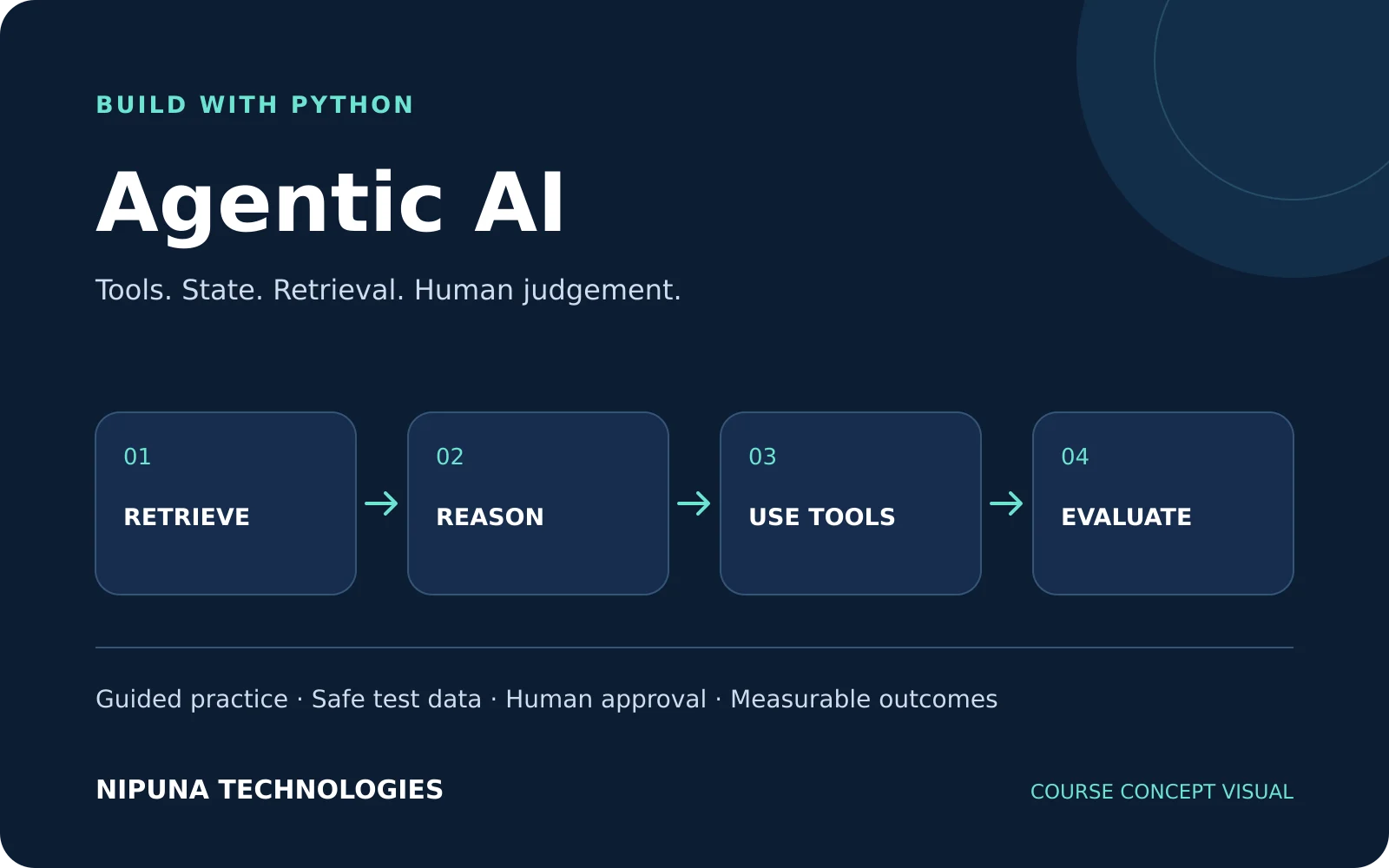
Set the task, tools, limits and success criteria.
Connect models, state, retrieval and validated tools.
Add human approval where actions need oversight.
Test success, failure, grounding, cost and recovery.
Exact platforms, libraries, connectors and model providers may vary by trainer and batch. Confirm paid account and API-credit arrangements before enrolment.
Build reusable agent functions, handle API responses and test behaviour.
Connect models, structure responses and handle timeouts, errors and usage costs.
Model stateful agent workflows with checkpoints and human review.
Connect retrieval, model and tool components in guided applications.
Validate structured inputs and outputs before a tool can act.
Retrieve relevant documents and ground answers in supporting evidence.
Index and retrieve relevant content, then measure retrieval quality.
Understand structured tool connections, permissions and trust boundaries.
Expose a tested application through an API with validation and clear responses.
Track changes, organise project work and document a reproducible handover.
Use approved test data, protect credentials, check normal and failure paths, and record execution evidence. The trainer confirms the sequence and practical scope for the current batch.
Build, test and record evidence of the result.
Build, test and record evidence of the result.
Build, test and record evidence of the result.
Build, test and record evidence of the result.
Build, test and record evidence of the result.
Project scope is adapted to learner readiness. Keep requirements, tests, limitations, review notes and a demonstration of your contribution.
Answer from approved documents with citations, retrieval checks and an explicit no-answer path.
Use permitted sources, track evidence and produce a reviewable brief with clear uncertainty.
Classify synthetic requests, retrieve relevant guidance and propose actions for staff approval.
Extract structured information, validate fields and route uncertain cases to a reviewer.
Plan an action, validate tool arguments, obtain approval and record the result without duplicate writes.
Deliver a selected agent use case with an evaluation set, security review, cost notes, demo and runbook.
Outcomes depend on attendance, practice and completion of assigned work.
Explain when an agent is useful and when a deterministic workflow is enough.
Build validated tool calls, retrieval and useful task state.
Measure task completion, correctness, grounding, latency and cost.
Demonstrate a working use case, failure handling and documented limitations.
Relevant portfolio directions include AI application development, junior agent engineering and AI integration work. Suitability depends on prior skills, practice and employer requirements. Career assistance does not guarantee employment, salary or placement.
Ask about applicable Nipuna Careers AI/LLM guidance, resume support, interview preparation and portfolio review for your selected branch and batch.
For learners in Guntur, start with a discussion of your Python readiness and the agent projects you want to build. The Guntur admissions team can confirm classroom arrangements, current batch timings and available learning modes.
Door No. 6-4-35, 1st Floor, 4/1 Arundelpet, Opposite Aditya Grand Hotel, Guntur, Andhra Pradesh 522002
+91 79979 27111
admin@nipunatechnologies.com
Modules can be updated, reordered or disabled from the admin panel.
Choose an agent only when adaptive tool use adds value.
Prepare the programming skills needed for the agent labs.
Build model calls with validated application outputs.
Enable an LLM to call your own application tools.
Build dependable loops that terminate correctly.
Model complex agent workflows as observable graphs.
Build agents with checkpointed state and human oversight.
Prepare content so an agent can retrieve reliable evidence.
Connect retrieval into the agent decision flow.
Make retrieval dynamic and self-correcting.
Understand structured and secure tool ecosystems.
Design systems of cooperating specialist agents.
Enforce safety boundaries on consequential agent actions.
Measure agent behaviour on consistent evaluation sets.
Reduce risks in agent inputs, outputs and connected systems.
Operate agents with visibility into failures and resource use.
Expose a reviewed agent service through a controlled application interface.
Present a bounded agent with evidence of useful and safe behaviour.
You will practise Python-based agents, tool calling, LangGraph workflows, state and memory, grounded retrieval, approval checkpoints, evaluation and deployment concepts through guided work.
Basic Python, functions, collections and API knowledge are recommended. The course includes a readiness refresher, not a complete replacement for a foundational Python programme. Discuss your current level before enrolling.
Agentic AI focuses on code-based agents and adaptive tool use. AI Automation focuses on connecting business applications and recurring workflows with platforms such as n8n, Make and Zapier.
No. This is a focused agent-engineering course. The existing Generative AI Developer with Python programme covers broader application foundations. Admissions can help you compare prerequisites and goals.
The toolkit includes Python, LLM APIs, LangGraph, LangChain, validation tools, retrieval components, FastAPI and Git. Exact libraries and provider versions are confirmed for the current batch.
The content includes guided agent labs and project briefs covering knowledge, research, support, document review and approved task execution, followed by a selected capstone. Project scope depends on learner readiness and the batch plan.
Applicable Nipuna LMS resources and class recordings support practice and revision. Confirm the access period, included materials and recording availability for your selected branch and batch.
Contact the Guntur admissions team for the current fee, duration, timetable, trainer and demo availability.
Model API usage, cloud hosting and paid platform plans may involve separate charges. Ask what the current batch provides before creating paid accounts or enrolling.
Use this page's location section for the current Guntur centre address and Directions link. Classroom, live online or hybrid options depend on the current course and batch.
Applicable Nipuna Careers AI/LLM guidance, portfolio discussion and interview support can help you plan next steps. Employment, placement and salary are not guaranteed.
Ask about the current trainer, timetable, mode, fee and demo availability.